

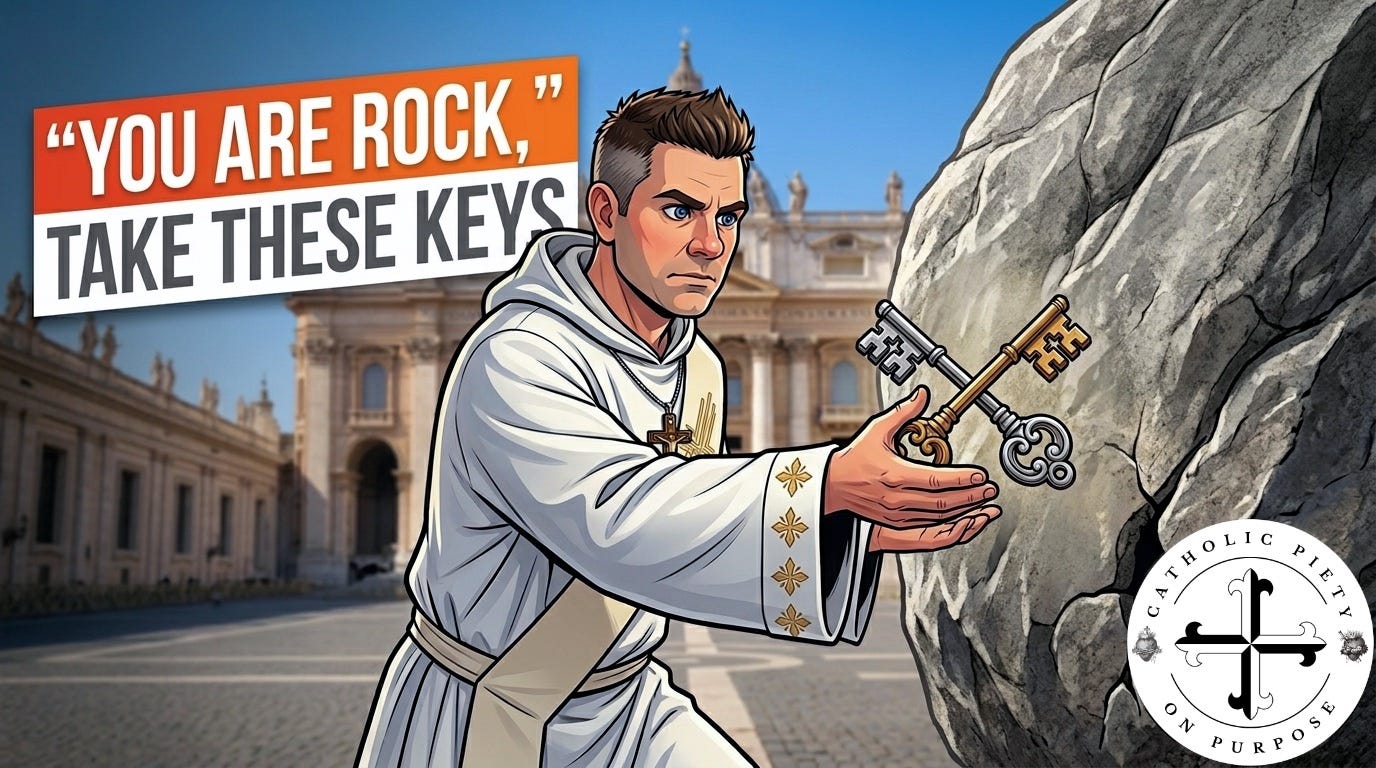
Welcome to another edition of Catholic Piety on Purpose! I’m your host, Rich Vancouit, and my goal is to help form intentional Catholics who are coming out of OCIA, are new to their faith, or just want to grow in holiness. This week, I want to hone right in on the biblical foundations of the papacy and how it was instituted by Christ from the Word of God.
The big scripture where this all starts is Matthew 16:17-19. After Peter declares that Jesus is the Christ, Jesus answers, “Blessed are you, Simon Bar-Jonah... And I tell you, you are Peter, and on this rock I will build my church... I will give you the keys of the kingdom of heaven, and whatever you bind on earth shall be bound in heaven”.
Everybody tends to focus heavily on the “rock” aspect of this passage. You’ll often hear arguments about the Greek words used here—that Petros means a little rock, while Petra means a big rock—suggesting that Jesus is the big rock and Peter is just a little rock. People use this to argue that the Church isn’t built on Peter. Honestly, I am completely fine with that argument. If you ask any Catholic who started our Church, we will tell you that Christ started His Church. It is not Peter’s church, the Pope’s church, or my church; it is Jesus’s Church, and He is the sovereign Lord.
While it is true that in Aramaic, the language Jesus likely spoke, the word Kepha (or Cephas) simply means “rock” without a size distinction—a name we see applied to Peter in John 1:42 and 1 Corinthians 1:12—arguing about rocks actually misses half the story. The true purpose of what Jesus was doing when establishing His Church isn’t found in a debate about rocks; it’s found in the very next verse.
In verse 19, Jesus says, “I will give you the keys of the kingdom of heaven”. When people question the Pope’s authority, we have to look at what these keys represent. To understand the purpose of this authority, we have to look at the Old Testament type and shadow found in Isaiah 22.
In Isaiah 22, we read a story about a bad steward getting kicked out and a new servant, Eliakim, taking his place. God says He will place on Eliakim’s shoulder “the key of the house of David,” giving him the power to open and shut. This established the office of the al habayath, which translates to the royal steward, master of the palace, or grand vizier. Within the administration of the Davidic kingdoms, this official was second in authority only to the sovereign king. While the king retained ultimate sovereignty, the royal steward actively managed the daily affairs of the kingdom—historically comparable to Joseph’s status under Pharaoh.
This is exactly what is happening in Matthew 16. Christ is the King, and He hands Peter the keys to the kingdom, effectively telling him to run the show and manage the daily affairs of the Church. When Peter binds and looses, he isn’t just making things up; he is conforming to God’s will, ensuring that his earthly decisions align with what is spiritually instituted in heaven.
By using this highly specific language about the keys, Christ doesn’t invent a new office. Rather, He restores and elevates the prime ministerial office of the Davidic dynasty within the newly established universal Catholic kingdom of the New Covenant. The Pope is not merely another bishop or theologian; he is the chief steward and Vicar of Christ on earth. Jesus gave the keys of the kingdom to the Pope to take care of His sheep and run the household of God while He is ascended into heaven, until His second coming.
May the Father, Son, and the Holy Spirit richly bless you!