

The Third Person: Unlocking the Action and Power of the Holy Spirit in Catholic Life
Introduction & Opening Prayer
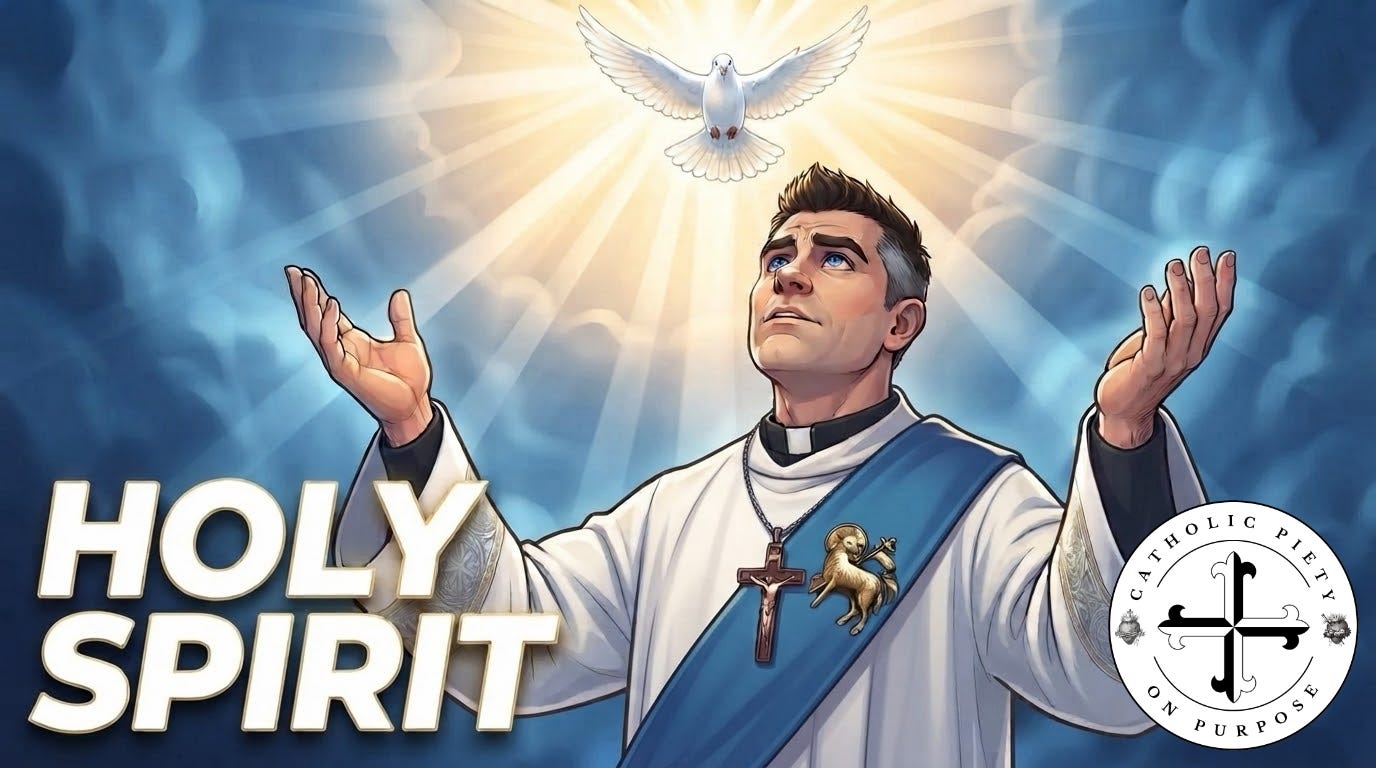
Welcome to Catholic Piety on Purpose with your host, Rich. In this feature, driven by a viewer’s request, we dive deep into the identity, power, and active role of the Holy Spirit. Before embarking on any task or spiritual study, it is a timeless Catholic custom to call upon the Spirit using the traditional prayer before work:
“Come, Holy Ghost, fill the hearts of the faithful, and kindle in them the fire of thy love”.
The Trinitarian Framework: Father, Son, and Holy Spirit
To understand the Holy Spirit, we must first look at the overall architecture of the Blessed Trinity. God the Father is the eternal, uncreated foundation in whom we all exist and have our being. He possesses absolute perfection in wisdom, intellect, love, and justice, with zero “potentiality”—meaning He is the ultimate first mover whom no outside force can change or move.
As supreme intellect, God speaks His divine Word. That eternal Word became flesh and dwelt among us as Jesus Christ, who is fully co-equal and consubstantial with the Father.
In the Old Testament, God’s presence was revealed directly through the Father or through pre-incarnate manifestations of the Son—such as the fourth figure who appeared alongside Shadrach, Meshach, and Abednego in the fiery furnace. Today, however, it is the Holy Spirit who acts as the dynamic, present operator within history and the Church.
Guiding the Church and Empowering Sacramental Life
The Holy Spirit’s primary domain today is the living Church and the interior life of every believer:
Guiding Church Doctrine: Within the Church, the Spirit dynamically moves the Magisterium, guiding ecumenical councils, dogmas, doctrines, and the Catechism to ensure the faithful are led into all truth.
Sacramental Regeneration: In Baptism, the Holy Spirit regenerates your soul, washing away original sin and raising you as a new creation in Christ.
Grace vs. “White-Knuckling”: Through sanctifying grace, the Spirit empowers you to achieve genuine holiness. Rather than trying to “white-knuckle” your spiritual development through sheer human willpower, authentic Catholic living relies on being actively led, filled, and sustained by God’s grace.
Navigating Catholic Prayer: Saints, Angels, and the Holy Spirit
Believers from non-Catholic backgrounds—such as Pentecostal traditions focused on praying through the Spirit to the Father in Jesus’ name—often ask when and how Catholics should address the Holy Spirit directly. With Mary’s intercession, guardian angels, and the Communion of Saints, prayer can sometimes feel crowded.
However, Catholic theology clarifies that these devotions do not conflict with one another:
The Lord of Hosts: God is called the “Lord of Hosts,” which literally translates to the Lord of Armies—a heavenly multitude of angels and saints interceding on our behalf.
Guardian Angels & the Spirit: When we pray the classic Guardian Angel prayer (“ever this day be at my side, to light and guard, and rule and guide”), the very functions of “ruling and guiding” flow directly from the Holy Spirit.
An Army of Intercessors: Asking for the intercession of Mary, your guardian angel, or the saints is like drawing upon a network of faithful friends who stand with you and pray for you. It is always God the Trinity alone who possesses the power to answer prayers and perform miracles.
Rather than choosing between the Holy Spirit and the saints, Catholics join with the entire heavenly army to worship God together.
Equipped for Holiness: The 7 Gifts and 12 Fruits
To carry out God’s will in daily life, the Holy Spirit endows believers with specific supernatural tools:
The 7 Gifts of the Holy Spirit: Wisdom, understanding, counsel, fortitude, knowledge, piety, and fear of the Lord. These gifts supply the supernatural light and strength needed for spiritual discernment, leadership, teaching, and service.
The 12 Fruits of the Holy Spirit: Charity, joy, peace, patience, kindness, goodness, generosity, gentleness, faithfulness, modesty, self-control, and chastity. As you cooperate with grace and advance in sanctification, these virtues naturally blossom in your character.
Through these gifts and fruits, the Holy Spirit continuously reveals God’s will to you and gives you the supernatural strength to execute it.
Conclusion
The Holy Spirit is not an abstract concept or distant force, but an active, loving Person of the Trinity constantly working to sanctify your soul and guide the Church.
If you have questions about Trinitarian theology or want to share how the Spirit is moving in your life, leave a comment below to continue the conversation! Have a blessed day, and stay tuned for the next episode of Catholic Piety on Purpose.