

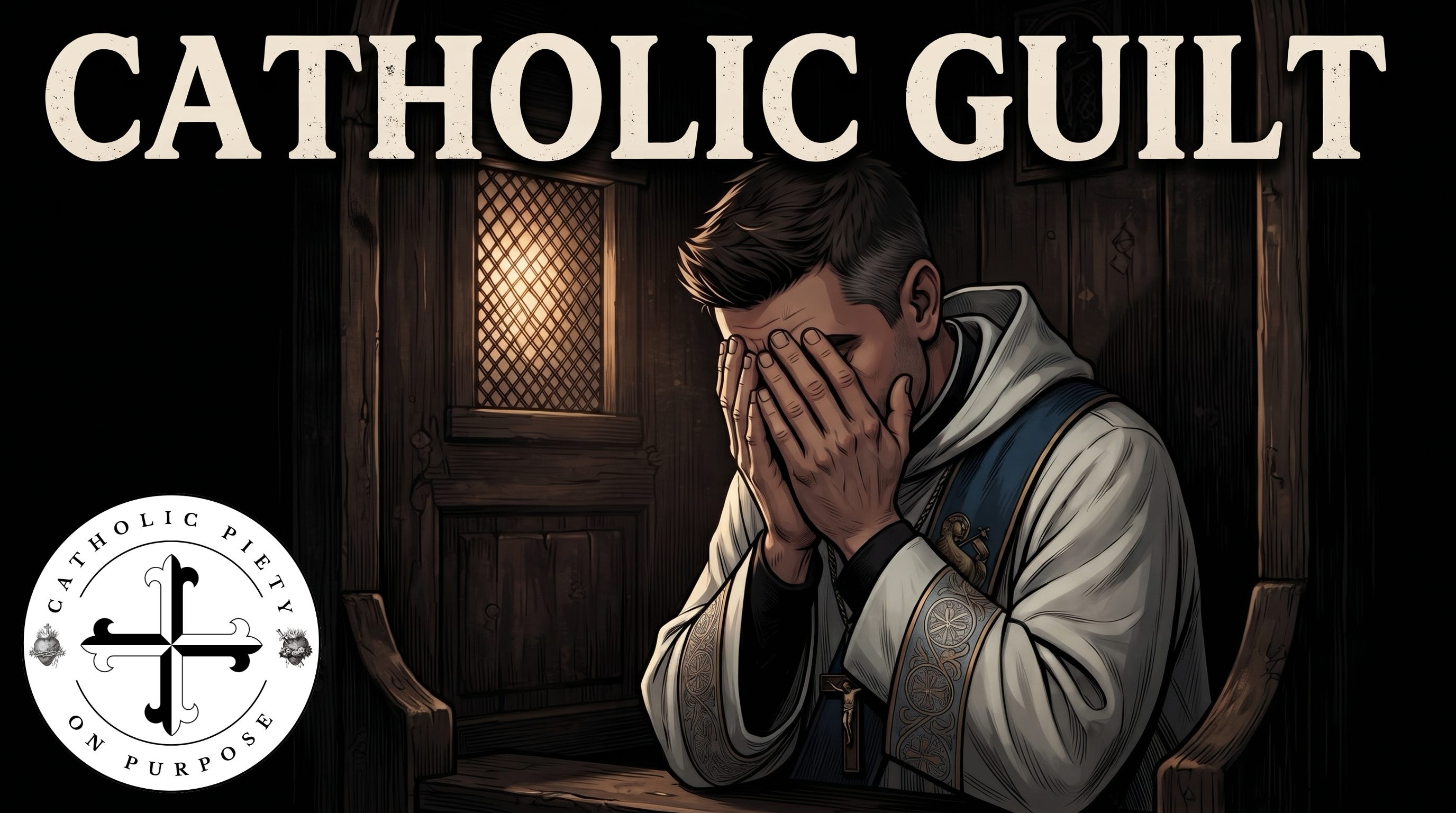
1. Introduction: A Friendly Text and an Honest Question
Welcome back to the podcast. Today, I want to dive into a recent text message exchange that got me reflecting deeply on “Catholic guilt,” mortal and venial sin, sacramental confession, and how the entire system of Catholicism intersects with our personal wiring.
It all started when my wife was chatting with an acquaintance and found out he was Anglican. Knowing we had another Anglican friend, she wondered if they might attend the same parish so she could help connect them. I texted my buddy to ask where he went to church. It turned out they didn’t attend the same place, but the next day he texted me back asking why I had asked. When I explained my wife’s thoughtful networking idea, he fired back a reply that made me stop in my tracks:
“Oh, I was thinking maybe you were thinking of coming to the Anglican church. It’s like being Catholic except without the overwhelming guilt.”
Now, if you know me, I love to talk a little trash and throw friendly banter back and forth. My immediate instinct was to push back: “I don’t have Catholic guilt! I don’t even know why you guys bring that up—that’s just old-school thinking that doesn’t happen anymore.”
But as I sat with it and decided to be completely honest with myself, I had to pause and ask: Do I have Catholic guilt? Is “Catholic guilt” actually a real thing? If the jab is out there on people’s radar, there has to be something to it. As a convert who has lived as a Christian for several decades, I realized that, yeah, I do live with a bit of it. Being a convert gives me a unique reference point on both sides of the aisle.
Before we jump deeper into the theological weeds, I need to give my usual disclaimer: I am a lay Christian, not a priest. I do not hold Holy Orders, nor do I speak for the magisterium of the Church. Some of this conversation touches on deep spiritual and psychological realities, so I strongly encourage you to sit down with your local priest or spiritual director to navigate your individual situation with someone who represents the Church’s authority.
2. The Theological Pendulum: Protestant Assurance vs. Catholic Responsibility
When examining how guilt operates, it helps to realize that different theological systems create different systemic tendencies. I like to think of it like a pendulum swinging between two extremes.
On one side, you have certain Protestant frameworks—such as Calvinism or “easy believism.” In this system, salvation is understood through legal imputation: Christ paid for all past, present, and future sins on the cross. Because salvation is viewed as an unalterable gift to the elect (”once saved, always saved”), there is no fear of losing your salvation or facing eternal condemnation. For someone in that framework, it can produce an incredible sense of freedom and joy. However, when that system is misapplied, the pendulum swings too far toward cheap grace, false assurance, and a total lack of reverence for God as Judge. You end up with a framework where personal sanctification and spiritual growth are completely ignored—where nobody asks if your faith could actually be proven by your bank account, your time, or how you live your daily life.
On the other side sits the Catholic sacramental system. Catholics believe that while nothing can forcibly rip us from the love of God, a person can make deliberate, repeated choices to walk away from salvation.
It’s also worth noting how many Catholics absorb this structure. Most learn these moral frameworks as grade-schoolers in CCD or confirmation classes, where they are just trying to pass a test. Many fall away as teenagers, only to return as adults trying to reconcile complex adult lives with a childhood understanding of sin and rules.
The Catholic Church teaches, as Scripture states, that there is a “sin that leads unto death” (mortal sin). To remedy this, God in His infinite mercy established sacramental confession, where a priest acts in persona Christi (in the person of Christ) to pronounce tangible, audible words of absolution: “I absolve you of all your sins.” Hearing those physical words provides a profound, concrete encounter with Christ’s forgiveness won on the cross.
However, if an individual’s personal temperament leans toward anxiety, this same Catholic system—lacking absolute “lock-in” assurance—can cause the pendulum to swing toward a scrupulosity loop, where the believer lives in constant terror of falling from grace.
Category
Protestant “Easy Believism / Calvinism”
Catholic Sacramental System
View of Salvation
Legal imputation; past, present, and future sins are fully paid for; salvation cannot be lost (”once saved, always saved”).
Initiated in baptism, but a believer can choose to walk away through deliberate “sin that leads unto death” (mortal sin).
Assurance / Fear
High subjective assurance; no fear of ultimate judgment or losing salvation.
Reassured through tangible sacramental absolution, but lacks absolute “lock-in” assurance if grave sin occurs.
Potential Systemic Pitfall
False assurance, cheap grace, lack of reverence for God as Judge, and ignoring personal character flaws.
Scrupulosity loop, constant guilt, paralyzing fear of hell, and doubting the validity of confessions.
3. Anatomy of Sin: Rules, Ambiguity, and the Confessional Line
To understand where spiritual anxiety develops, we have to look at how the Church defines sin. According to the Catechism of the Catholic Church, three criteria must simultaneously be met for a sin to be mortal:
Grave Matter: The act itself must be serious (correlating to moral principles like the Ten Commandments).
Full Knowledge: The person must know that the act is wrong and grave.
Deliberate Consent: The act must be committed with full, free exercise of the will.
Here lies a fascinating paradox of human nature: as human beings, we constantly demand rules, laws, and to-do lists so we can measure where we stand. But the second we are handed that list, our pride rebels. It burns our pride. We complain about the boundaries, or we start searching for clever excuses to dismiss the list entirely.
Furthermore, applying these rules creates intense psychological ambiguity for the average layperson. As an old adage goes: “If everyone’s special, no one’s special; if everything’s mortal, nothing’s mortal.” When examinations of conscience list broad categories under the Ten Commandments, it leaves the layperson paralyzed, wondering where the line actually lies.
The Catechism explicitly states that gravity exists on a spectrum—for instance, murder is graver than theft. We intuitively know that stealing a pen from work is fundamentally different from mugging someone on the street or robbing a bank. Yet, reading through standard examination lists can make everything feel equally catastrophic.
I catch myself laughing at this dynamic when I’m standing in the confession line. I’ll look ahead and see four or five elderly ladies holding notebooks. Now, full confession: my immediate, selfish thought is, “Man, this is going to take forever”—which is a sin of impatience right there on my part! But my second thought is, “You’re 78 years old... what grave matter could you possibly be getting into?” I’m pretty sure they aren’t out robbing banks on the weekend! This everyday confessional experience highlights just how confusing and heavy the boundaries between mortal and venial sin can feel to a layperson trying to parse out daily human flaws.
4. Neuro-Highways and Consent: How Habits and Addictions Alter Imputability
The third criterion for mortal sin—deliberate consent—is where physical science, psychology, and theology directly overlap.
Catholic teaching explicitly recognizes that complete consent can be diminished. The Catechism notes that the promptings of feelings and passions, external pressures, unintentional ignorance, or pathological disorders can diminish or even remove the voluntary character of an offense.
Consider deeply ingrained habits and compulsions, such as a phone or scrolling addiction driven by dopamine loops. Every single time a behavior is repeated, it digs physical “neuro-highways” or trenches in the brain. Over time, your nervous system demands that loop. When a trigger hits, a person’s physical nervous system can spike to the point where they feel like they almost “blacked out” before giving in. Afterwards, flooded with shame, they ask: “Why am I not more spiritual?”
I’ll get a little raw here and share a personal struggle. I remember standing in the confessional line, preparing to confess a habit I had fought for 30 years, thinking to myself: “Does this long-term habit lower this to a venial sin so I don’t have to keep running back here every other day? I’m not looking for an excuse to sin, but Father, I must be wearing you out!” But I realized quickly that a fast-moving, two-minute confessional line is not the place to resolve deep-seated, decades-old psychological and physical loops. That requires dedicated spiritual direction and comprehensive care.
Approaching deep habits purely as a spiritual battle—relying strictly on prayer, fasting, and the Rosary—often misses the physical reality of how God built our bodies. Healing requires a multi-front strategy:
Spiritual Tools: Continual prayer, fasting, regular reception of the sacraments, and dedicated spiritual direction.
Physical & Psychological Care: Partnering with medical professionals, counselors, and therapists to actively rewire physical neuropathways.
A Firm Caution: We must never manipulate the physical reality of lowered consent into a convenient “loophole” to comfortably remain in sin. It is extremely dangerous to say, “Well, this is just a neuro-highway, so it’s only venial and I can keep doing it without guilt.” Lowered consent is not an excuse to remain stagnant; it is an explanation to guide how you seek holistic healing.
5. Deconstructing “Catholic Guilt”: System vs. Scrupulosity
So, what is the root cause of “Catholic Guilt”? Is the Catholic Church to blame, or is it something else?
To answer this, we must look at scrupulosity: an agonizing spiritual condition where a person lives in constant, obsessive fear that they are in mortal sin, bound for hell, or that their past confessions were invalid. It creates a horrific loop where a believer feels compelled to run back to the confessional constantly, making their entire spiritual life revolve around fear.
When you step back, you realize that while Catholic guilt is real, it is not inherently the fault of the Church.
In fact, if you look at the opposite extreme—the Protestant “easy believism” framework—you often find what I call “the most joyous sinners you ever seen.” They experience zero guilt and total emotional freedom, yet they frequently fail to work on their personal sanctification, character flaws, or moral growth.
Catholic guilt occurs at the precise intersection of a structured system and an individual’s personal temperament. Holy Mother Church provides clear moral boundaries out of deep love, knowing that human beings drift without structure. But when that structural system meets specific personal factors, spiritual anguish is produced:
Personal Temperament & Wiring: A natural, innate disposition toward anxiety, worry, or obsessive-compulsive tendencies.
A Performance-Based Mindset: A psychological pattern (often rooted in personal trauma, family dynamics, or upbringing) where a person measures their worth solely by their ability to flawlessly execute a to-do list.
Systemic Rules & Structure: Clear definitions of moral boundaries, which a scrupulous mind weaponizes against itself in an attempt to “earn” God’s love.
When an anxious, performance-driven person enters a structured sacramental system, they attempt to achieve spiritual safety through perfectionism. When they inevitably stumble, they spiral into guilt.
6. Conclusion: Finding Freedom in the “Pocket” of Divine Mercy
If you are listening to this and finding yourself crushed under the weight of legalism and scrupulosity, you need to stop pounding yourself with the law and fix your eyes on the Cross.
Look to the message of Divine Mercy given through St. Faustina, whose entire diary stands as a monument to the infinite, unmerited love of God. Jesus did not shed His blood on Calvary so that you would spend your life in perpetual terror; He did it to set you free.
The ultimate goal of the Christian life is to live in “the pocket”—that sweet middle ground between two dangerous theological extremes:
Licentiousness (The Left Extreme): Treating God’s grace as a “license to ill,” completely ignoring personal sanctification, growth, and reverence for God as Judge.
Legalism & Scrupulosity (The Right Extreme): Living in paralyzing fear, forgetting that Christ paid the price for your soul out of overwhelming love.
Living in the pocket means resting fully in the mercy, passion, and unmerited love of Jesus Christ while intentionally pursuing holiness. That balance is the very definition of practicing Catholic piety on purpose.
If you are trapped in cycles of guilt, please reach out to a trusted priest, a spiritual director, or a licensed therapist. Do not let guilt hide the loving face of God from you. You are a beloved child of the Father, and Christ desires for you to walk in His true joy, peace, and freedom.
I’ll see you in the next episode. God bless you.