

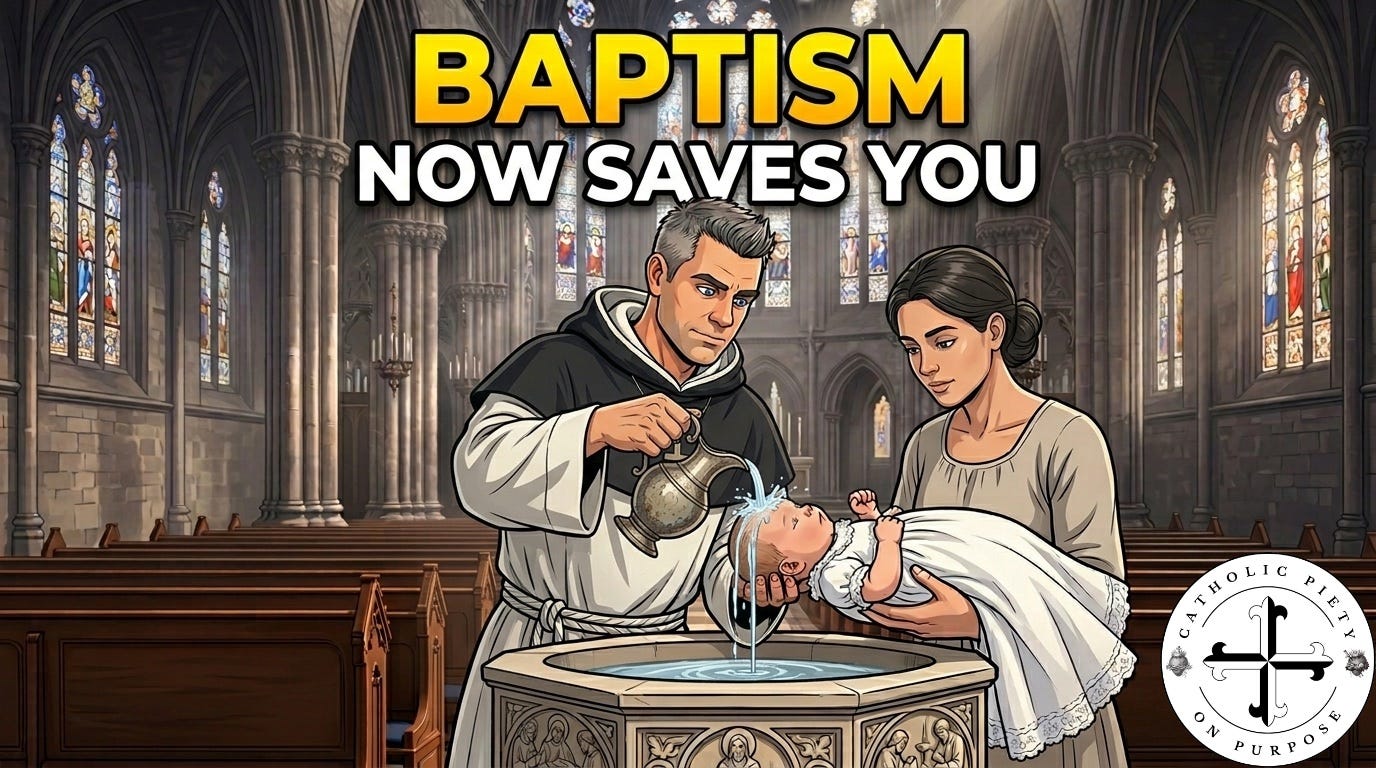
If you are a new Catholic, a revert, or simply someone trying to deepen your understanding of the faith, the sacraments can sometimes feel overwhelming. In this episode of the Catholic Piety on Purpose podcast, I tackle what can be a controversial topic for those coming from outside the Catholic Church: the doctrine of baptismal regeneration.
Drawing from his own two-decade journey through Calvinist, Reformed, Pentecostal, Baptist, and non-denominational Protestant traditions before reverting to Catholicism, I offer a unique perspective on why the Catholic Church teaches that baptism is far more than just an empty symbol.
More Than an Outward Symbol
A common belief in many modern Christian traditions is that baptism is simply an outward symbol of an inward faith—a public declaration made after a person is already saved. However, the Catholic Church teaches that baptism fundamentally alters who you are at the deepest level of your being.
According to the Catechism of the Catholic Church (Paragraph 1213), baptism is the “basis of the whole Christian life, the gateway to life in the spirit,” through which we are freed from sin and reborn. This view is deeply rooted in Scripture. In 1 Peter 3:21, the Bible explicitly states, “Baptism, which corresponds to this, now saves you, not as a removal of dirt from the body but as an appeal to God for a clear conscience”.
Just as the waters of the flood in Noah’s time simultaneously destroyed the sin of the world and saved the eight people inside the ark, God uses the waters of baptism to remove our sin and save us.
Is Baptism a “Work”?
One of the biggest hurdles for Christians coming from Protestant backgrounds is the fear that requiring baptism detracts from the total sufficiency of Christ’s sacrifice on the cross. If we are saved by faith alone, doesn’t baptism become a human “work”?
The historical Christian understanding is actually the exact opposite. If baptism were merely an outward symbol of obedience to a command, that would be a human work. In the Catholic understanding, baptism is a “means of grace”. You are not doing the work; Christ is doing everything. When the water is poured in the name of the Father, the Son, and the Holy Spirit, it is the Holy Spirit who comes upon you and regenerates you based on what Christ accomplished on the cross.
Historically, from the Book of Acts until the era of modern American revivalism, professions of faith were immediately tied to baptism. When people were cut to the heart by the Gospel, the apostles didn’t lead them in a “sinner’s prayer” or issue an altar call. Instead, as Peter proclaimed at Pentecost, they were told to “Repent and be baptized, every one of you, in the name of Jesus Christ, for the forgiveness of sins”. We see this again with Philip and the Ethiopian eunuch, who immediately went down into the water to be baptized upon hearing the good news.
What About Infant Baptism?
The podcast also addresses a frequent question: Why does the Catholic Church baptize infants instead of waiting for a “believer’s baptism”?
The Church actually embraces believer’s baptism for adults who come to the faith, but extends this grace to their families as well. In the Old Testament, the covenant of Abraham utilized circumcision on the eighth day as the physical sign of entering God’s family. The Apostle Paul explicitly calls baptism the “circumcision of Christ” (Colossians 2:11-12).
Because baptism is the new entry point into the family of God, the New Testament repeatedly shows entire households being baptized when the head of the household comes to faith. This includes the household of Lydia, the family of the Philippian jailer, and the household of Stephanas. The promise of salvation is “to you and to your children” (Acts 2:39).
The Witness of the Early Church
This understanding of baptism wasn’t invented centuries later; it was the reality of the early Christians who learned directly from the apostles. Ancient documents confirm that the earliest Christians believed in baptismal regeneration:
The Letter of Barnabas (74 AD): “We go down into the water full of sins and foulness. And when we come up bearing fruit in our hearts, fear and hope in Jesus...”
The Shepherd of Hermas (80 AD): “They go down to the water dead and they come up alive.”
Justin Martyr (151 AD): Writes that new converts are “regenerated in the same manner in which we ourselves were regenerated.”
Furthermore, early Church Fathers like Irenaeus (189 AD) and Origen (248 AD) explicitly confirm that the Church received the tradition of baptizing infants directly from the apostles to wash away the innate stain of original sin.
A Once-and-for-All Sacrament
Because baptism is God’s work and not our own, it only needs to happen once. Just as Christ’s sacrifice on the cross was a one-time event, your baptism permanently regenerates you and brings you into the body of Christ. While we must continually nurture that faith and deal with our actual sins throughout our lives, the stain of original sin is washed away.
So, “Baptize your babies”. It is the profound, biblical, and historical way that Christ invites us into His life-saving grace.
+JMJ+
Rich