

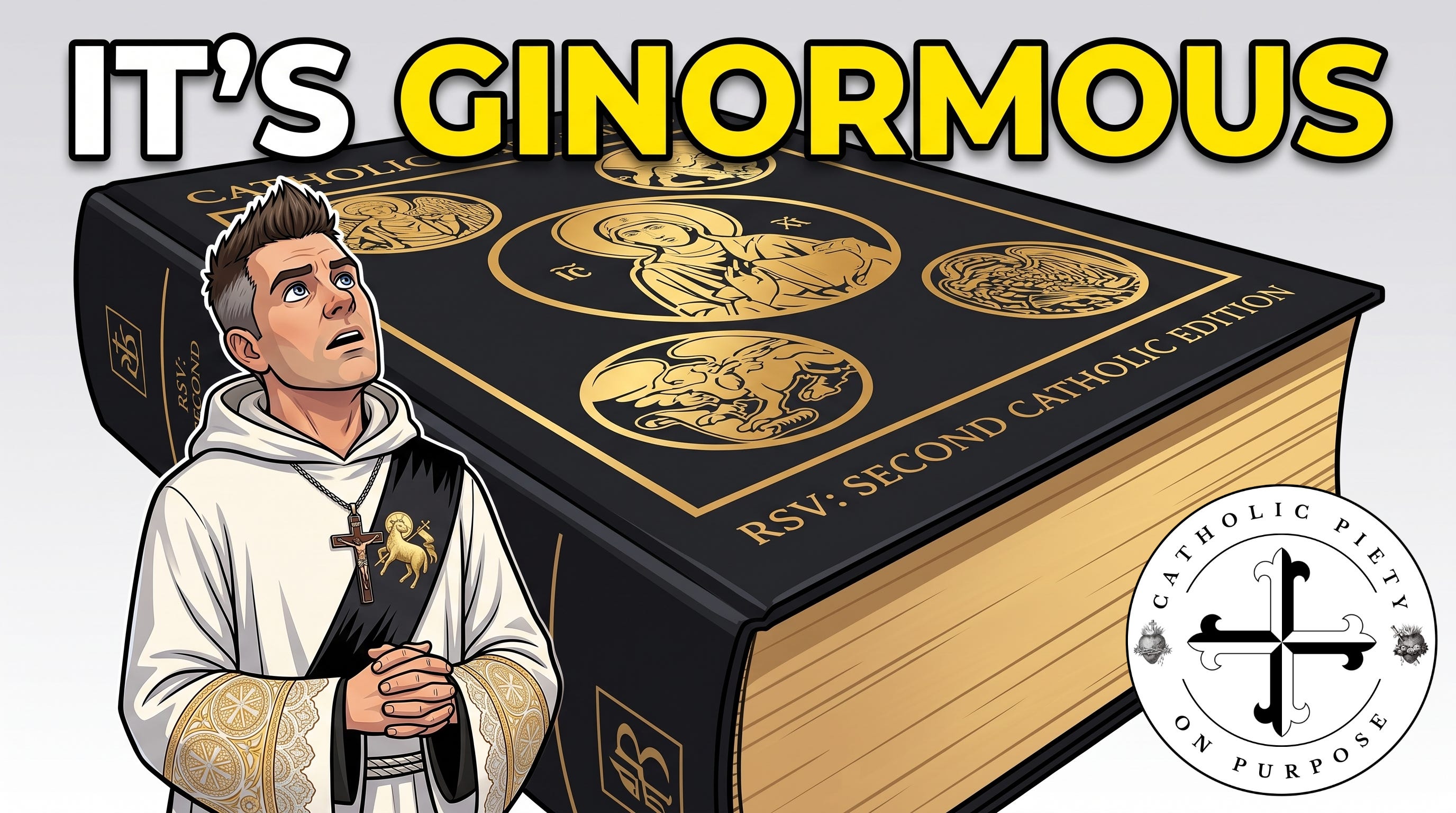
Welcome to another episode of Catholic Piety on Purpose; I’m your host, Rich, and today we are talking about the Catholic Bible. If you have ever held a Catholic study Bible, you might have noticed it’s a ginormous beast of a book. While study Bibles are naturally large because of the commentary, there is a fundamental technical difference between the Bible I used as a Protestant and the Bible I now use as a Catholic: the Catholic Bible has seven more books. In the Protestant world, I was used to a 66-book Bible, whereas Catholic churches use a 73-book Bible, containing 46 books in the Old Testament and 27 in the New Testament.
I was always told that Catholics “added” books to the Bible to invent new doctrines that weren’t originally there. However, historically and mathematically speaking, this is incorrect. How can you add books to something that existed before you? The Protestant Reformation happened in 1517, but the biblical canon was established centuries prior.
How the Canon Was Compiled
In the early days of the Church, the apostles wrote the Gospels and epistles, and the apostolic deposit of faith was preached as churches were established. Eventually, teachings considered solid were tested by heresy, with people introducing forged texts like the Gospel of Thomas. To protect the faith, the Church had to hold councils to dogmatically establish which texts were authentic.
The canon of the Bible was first solidified in 382 AD at the Council of Rome under Pope Damascus I. This 73-book list was affirmed again at the Councils of Hippo in 393 AD and Carthage in 397 AD and 419 AD, which were heavily influenced by St. Augustine. Finally, in 1546, the Council of Trent infallibly defined the 73-book canon as dogma, largely in response to the Reformation removing those exact seven books.
The Septuagint vs. The Masoretic Text
When compiling the Old Testament, the Catholic Church relied on the Septuagint. This was a Greek translation of the Hebrew canon created around the 3rd or 2nd century BC by Greek-speaking Jews. Because the early Christian Church and the world at the time of Jesus were predominantly Greek-speaking, this larger canon became the established norm.
During the Reformation, Protestants instead turned to the Masoretic text. This text was standardized in Hebrew by Jewish rabbis between the 7th and 10th centuries AD, meaning it was compiled in a post-Jewish world that had already rejected the Messiah. While going back to the “original” Hebrew sources might have seemed like a noble idea, it relied on a canon finalized centuries after Christ’s death and resurrection.
The Deuterocanonical Books and St. Jerome
Catholics refer to these seven books as the Deuterocanonical books (meaning “second canon”), while Protestants call them the Apocrypha (meaning “hidden” and “uninspired”). These books include Tobit, Judith, 1st and 2nd Maccabees, Wisdom, Sirach, and Baruch, along with extra portions of Esther and Daniel.
There was some debate in the early Church. When Pope Damascus tasked St. Jerome with translating the Bible into Latin, Jerome was initially hesitant about these seven books because the Hebrews he was studying with did not use them. However, Jerome ultimately submitted to the Pope and the Church council, including all 73 books in his famous Latin Vulgate. This demonstrates the early Church’s reliance on the authority of councils and the Holy Spirit handing down decisions to the apostles’ successors.
The Doctrinal Divide
Beyond the translation differences, the removal of these books ultimately came down to authority and doctrine. These seven books contain explicitly Catholic doctrines that the Reformers rejected, such as praying for the dead, praying to the saints, and Purgatory.
A major linchpin for this is 2 Maccabees 12:45. After a battle during the Maccabean revolt, Judas Maccabeus and his men discover that some of their fallen soldiers were wearing amulets of false gods. In response, they send an offering to the temple to make sacrifices for the dead, hoping to help them in the afterlife. This provides a scriptural foundation for the concept of a purging process after death—what Catholics call Purgatory—for those who die in friendship with God but still have an attachment to sin.
Because the Reformers were establishing doctrines like Sola Scriptura (Scripture alone), they had to remove texts that contradicted their new theology. Martin Luther even had a problem with New Testament books, famously calling the Book of James an “epistle of straw” because it explicitly states that we are not saved by faith alone.
The Beauty of the 73 Books
If you have never read these seven books, you are missing out on some incredibly beautiful passages. For instance, the Book of Wisdom contains a staggering prophecy about Christ’s crucifixion that rivals the prophet Isaiah.
Wisdom 2:12-20 reads: “Let us wait for the righteous man because he is inconvenient to us and opposes our action. He boasts that God is his father. Let us test him with insult and torture. Let us condemn him to a shameful death”. When you read it, you can clearly see it prophesying exactly why the Pharisees and Sadducees would ultimately condemn Jesus.
Whether you are a new Catholic convert, going through OCIA, or a lifelong Catholic looking to dig deeper into your faith, don’t be afraid of these extra books. They were preserved to glorify Christ. Grab your 73-book Bible and discover this beauty for yourself! I pray you are having a blessed summer, and I’ll see you on the next one.
♥️✝️